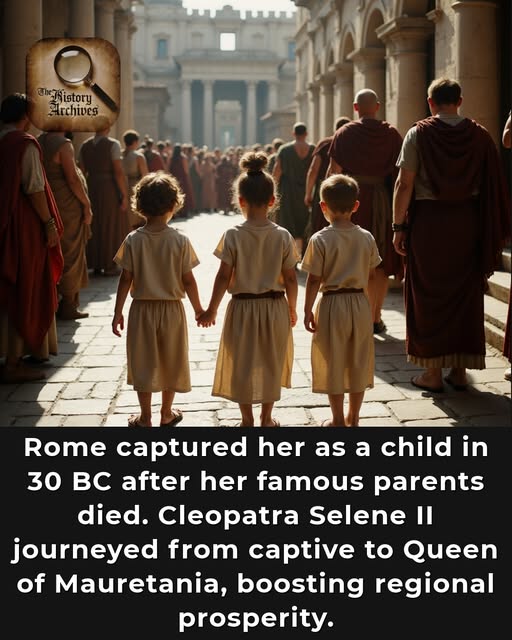
Captured as a child, Cleopatra Selene II’s journey from Roman captive to African queen is a remarkable tale of resilience.
Her parents, the famed Cleopatra VII of Egypt and Roman general Mark Antony, met their end in 30 BC. This followed their decisive defeat at the Battle of Actium the previous year.
The aftermath was harsh for their children. Caesarion, Cleopatra’s son with Julius Caesar, was considered a threat by Octavian and was executed.
What then of Antony’s children with Cleopatra: Alexander Helios, Cleopatra Selene II, and Ptolemy Philadelphus? They were spared but paraded in Octavian’s triumph and taken to Rome. 
There, their lives took another turn. It is widely believed that Octavia Minor, Mark Antony’s former Roman wife and Octavian’s sister, took them into her own household to raise them.
Some historical accounts note they may have lived with other Roman relatives, but Octavia’s care is the most prominent narrative.
While the fates of her brothers, Alexander Helios and Ptolemy Philadelphus, are obscured by history, with suggestions they died young, Cleopatra Selene II’s path is clearer.
She was eventually married to King Juba II of Numidia and became a respected queen of Mauretania, an influential client state of Rome. 
Cleopatra Selene II’s reign in Mauretania brought prosperity and fostered cultural development, a significant legacy for a queen who began her life in Rome as a captive. 


