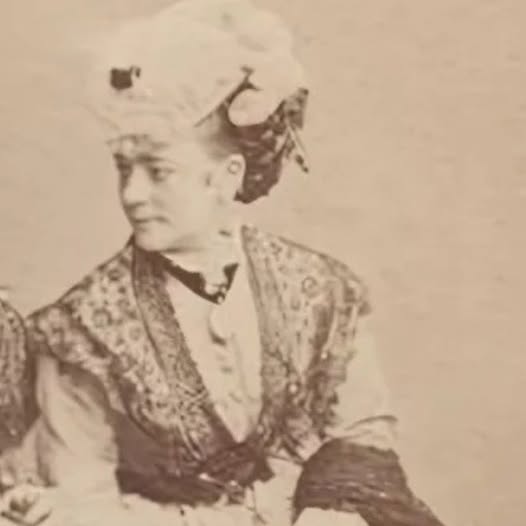
She began with nothing. Born around 1842 into the kind of poverty that rarely forgives, Kate Cooke carved a path most women wouldn’t dare to imagine, let alone walk.
As a teenager, she joined the circus—part of a traveling world of illusion and grit—riding horses under the tented sky and living with a showman whose name she took and whose temper she endured.
When his violence became too much, she left him and married a commercial traveler in Glasgow. It was a brief union. After five months, he disappeared, leaving her without money or protection in a time when abandonment often meant ruin.
In 1864, Kate made her way to London. She found herself at a brothel in Pimlico, where fashion and survival were closely tied. Within hours of arriving, she was in debt to Rosalie Bernstein, a widow who dressed the women of the house in finery on credit, to be paid back in cash—or in kind.
Kate’s transformation was swift. She became a familiar figure at the Argyle Rooms, Cremorne, the Holborn Casino—places where women weren’t just seen but judged, appraised, desired. She cultivated an aura of glamour, of danger, of untouchable elegance. There was no shortage of men eager to escort her, to sponsor her beauty. But debts followed glamour like shadows.
Her falling-out with Rosalie Bernstein, now Mrs. Ochse, made headlines. The Ochses sued Kate for hundreds of pounds in unpaid clothing—fine parasols, silk gowns, lace undergarments, the armor of the high-class courtesan. But the law surprised everyone. Because the clothing had been knowingly supplied to aid a woman in prostitution, the court refused to enforce payment. The verdict was in Kate’s favor. Her secrets had been aired, her profession confirmed, and yet—she won.
And then, the unthinkable happened. In 1871, under the name Kate Walsh Smith and claiming widowhood, she married the Honourable Henry James Fitzroy, heir to a ducal title. Whether love, ambition, or calculation drove her, we don’t know.
What’s certain is that for three years, she lived as a wife in name, though her husband left for Australia in 1875 and stayed for six years. When he returned and tried to nullify their marriage—accusing Kate of #bigamy—the case turned into yet another public trial of her character. But once again, the truth was more complicated than expected.
The man she had first married in Glasgow, George Manby Smith, was himself already married at the time. His union with Kate had never been legal. Her marriage to Lord Euston stood.
From circus rider to courtesan, from courtroom spectacle to countess, Kate Cooke defied every convention the Victorian world tried to impose on her. She kept her title until her death in 1903. She didn’t leave behind heirs, but she left a story—a reminder of how power, scandal, and womanhood could be wielded like a blade.


