In 1860, the Clotilda became the last known sl@ve ship to bring ensl@ved Africans to the continental United States, illegally transporting over 100 people to Alabama decades after the transatlantic sl@ve trade had been banned.
Among those captured was Oluale Kossola, later known as Cudjo Lewis, who endured unimaginable horror as he was torn from his home in present-day Benin and forced across the Atlantic.
After the Civil War ended, he and other survivors founded Africatown, a community near Mobile, Alabama, where they preserved their language, customs, and stories for generations.
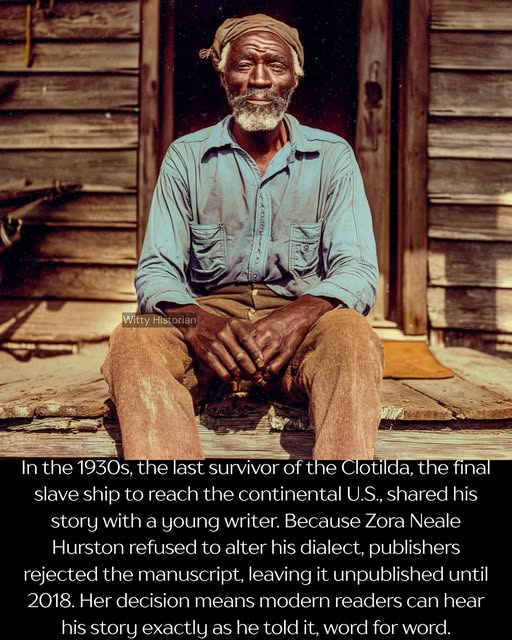
By the 1930s, Cudjo was the last known survivor of the Clotilda, still living in Africatown and carrying the memories of his forced journey and survival through sl@very.
In 1927, Zora Neale Hurston, a young Black writer and anthropologist, interviewed Cudjo Lewis over several months, recording his words exactly as he spoke them.
Publishers at the time refused to release Hurston’s manuscript because she preserved his authentic dialect, which they considered unpolished and controversial.
The manuscript, titled Barracoon, remained locked away for nearly a century until it was finally published in 2018, allowing modern readers to hear Lewis’s voice word for word.
His firsthand testimony is a powerful reminder of a brutal chapter in American history, highlighting both the pain of ensl@vement and the resilience of a man who refused to let his story d!e with him.