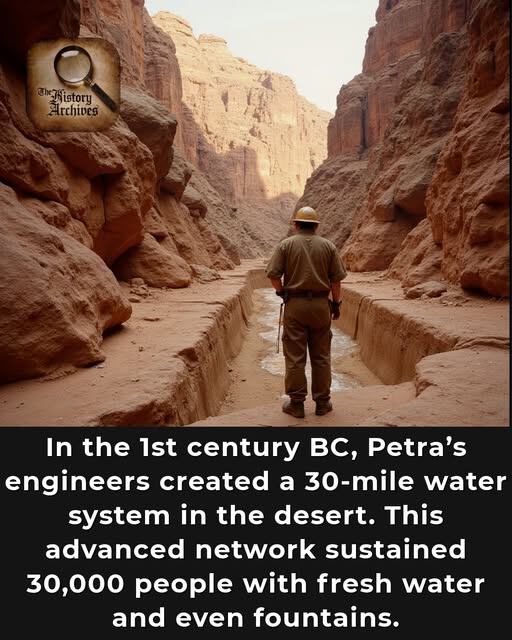
Hidden in Jordan’s red sandstone cliffs, a 2,000-year-old city defied the desert with an engineering secret so advanced, it powered fountains in a land without rivers.
The Nabataeans, skilled engineers of antiquity, transformed Petra into a remarkable desert oasis. They accomplished this by constructing an extensive network spanning over 30 miles.
This hydraulic infrastructure included meticulously carved channels, dams, terracotta pipelines, and numerous underground cisterns. These innovations captured scarce rainwater and vital spring flows.
Their engineering allowed for the delivery of approximately 35 million gallons of water annually. This sustained a bustling population estimated around 30,000 people during the 1st century BC and 1st century AD.
The water system enabled not only survival but also public fountains, and supported agriculture in an arid environment. Ingenious terrain-carved channels redirected flash floods into reservoirs, preventing potential disaster.
Furthermore, pressurized pipelines, cleverly utilizing gravity, distributed precious water across the city’s varied slopes. While earlier desert water systems existed, Petra’s scale and sophistication were exceptional for its time.
After 106 AD, when the Romans took control, they expanded upon the existing system. However, the core Nabataean engineering principles were preserved and continued to function for centuries, a testament to their advanced design.


