Halfway through cutting his own abdomen in the middle of Antarctica, Dr. Leonid Rogozov’s vision blurred. ‘My hands felt like rubber,’ he wrote, but stopping meant certain death.
It was April 1961, and the 27-year-old Soviet physician was stationed at the remote Novolazarevskaya Station.
Suddenly, he developed severe abdominal pain. Rogozov, the only medical professional on the base, quickly diagnosed himself with acute appendicitis.
A fierce blizzard raged outside, grounding all aircraft. The nearest Soviet base was over 1,000 miles away. Evacuation was impossible.
Faced with a grim choice, Rogozov decided to perform the surgery on himself. It was his only chance.
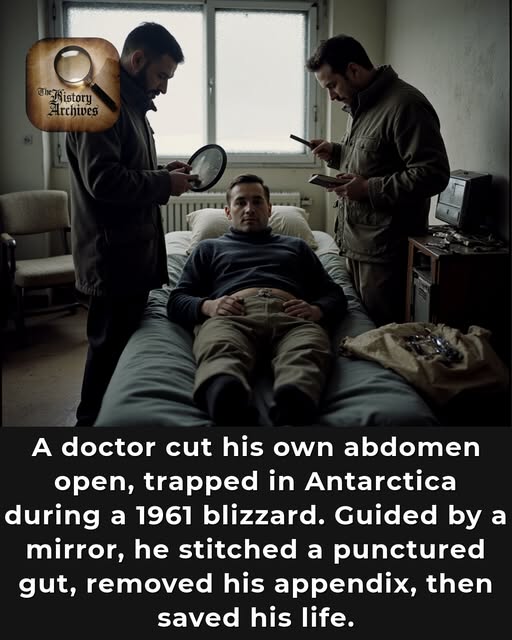
Lying semi-reclined, he administered local anesthetic. A meteorologist held a mirror to guide him, while a driver handed instruments, ready to inject adrenaline if he lost consciousness.
The operation began around 2 AM local time on May 1st. For nearly two agonizing hours, Rogozov fought fainting spells and nausea as he carefully worked.
Using the mirror’s reflection, he made the incision. Finding the appendix was difficult, and at one point he accidentally injured his cecum, requiring emergency stitches mid-operation. 
Despite the immense pain and weakness, he located and removed the diseased appendix, applying antibiotics directly into the wound before closing the incision.
Though weakened, Rogozov directed his assistants through the final steps. He made a full recovery within two weeks.
His incredible act of self-preservation remains a legendary tale of survival under extreme conditions.


