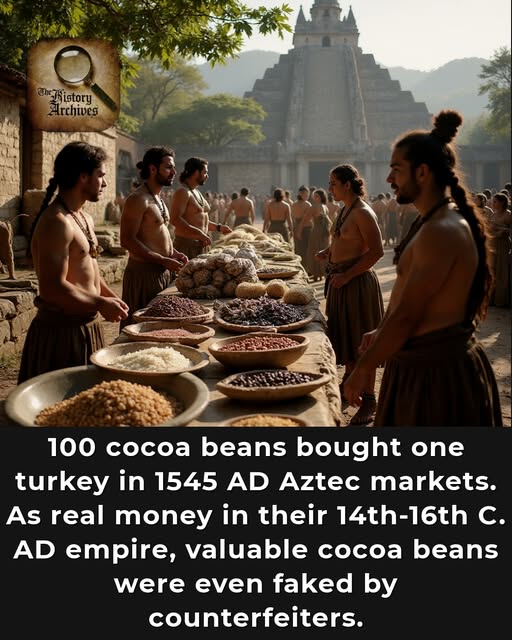
In the Aztec empire, a peculiar currency was once king: the humble cocoa bean. It was so valuable that 100 beans could buy a turkey.
The Aztec empire, which flourished from the 14th to the 16th century AD, had a fascinating economic system where these beans were a primary form of money. 
Cocoa beans weren’t just for making a drink; they were the coins of the realm. This use is documented in historical texts, including records from the time like the Codex Mendoza.
Around 1545 AD, a list from Tlaxcala, an area within the Aztec sphere of influence, showed that a good turkey hen was valued at 100 cacao beans. 
Beyond their monetary use, cacao held deep cultural and economic significance throughout Mesoamerica. It was truly a gift of the gods to them.
It’s interesting to know that cocoa beans weren’t the only form of currency. The Aztecs also utilized other items like cotton textiles, known as quachtli, and even copper hatchets for larger transactions.
Using a food item as money did have its challenges. Cocoa beans were perishable, meaning they wouldn’t last indefinitely, and they could be bulky to transport in large quantities.
There were even reports of people trying to counterfeit these edible coins. Some would craft fakes from amaranth dough or wax, trying to pass them off as genuine cocoa beans.
Despite these issues, the system worked for their society, showing a unique approach to commerce based on a highly valued local resource.


