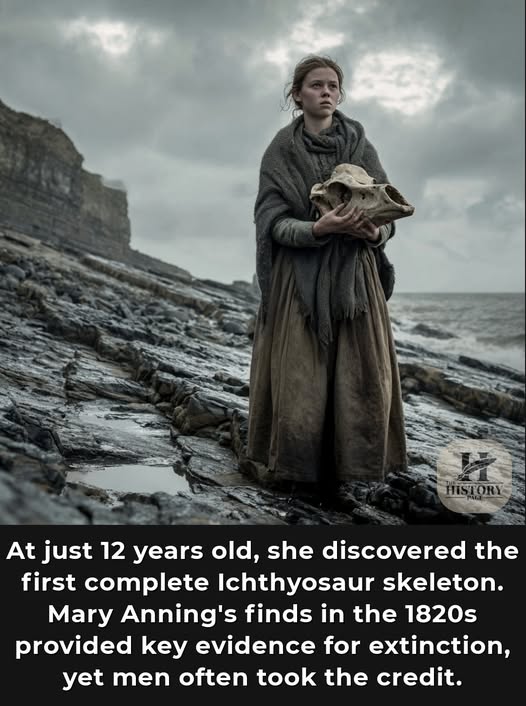
At just 12 years old, Mary Anning made a discovery that would permanently alter our understanding of the ancient world.
Born in 1799 in the coastal town of Lyme Regis, England, Mary came from a poor family. They supplemented their income by finding and selling ‘curiosities’—what we now know as fossils—from the crumbling seaside cliffs.
In 1811, Mary and her brother Joseph found something incredible. Joseph first uncovered a four-foot-long skull, and a year later, Mary painstakingly excavated the rest of the 17-foot skeleton from the cliffside. 
It was the first complete skeleton of an Ichthyosaur, an ancient marine reptile, ever discovered. The scientific community was stunned.
She didn’t stop there. In 1823, Mary unearthed the first complete Plesiosaur skeleton. The find was so strange that some scientists initially dismissed it, but its authenticity was eventually confirmed.
Later, in 1828, she discovered the first Pterosaur skeleton found outside of Germany, a prehistoric flying reptile. 
Despite her groundbreaking work, Mary faced incredible barriers. As a woman from a working-class background, she was barred from joining scientific societies like the Geological Society of London. Often, male scientists would buy her fossils and publish papers about them without giving her credit.
Her discoveries, however, provided some of the first and most compelling evidence for the concept of extinction, a challenging idea for the time.
Though she rarely received formal credit during her life, Mary Anning’s meticulous work and profound discoveries established her as one of the most important figures in the founding days of paleontology.


